San Fransisco Chronicle: “AfroTech is ‘a really powerful gathering that’s about more than just tech. It’s really about the affirmation of people’s value and potential,’ said Cedric Brown, the Kapor Center’s chief foundation officer. ‘There are plenty of intellectual assets and capital that we possess in our community, and it’s playing out in this sector.’

PBLWorks Introduces PBL School Leader Networks: First two cohorts will launch in Los Angeles and Massachusetts
“PBLWorks, the leading provider of professional development for high-quality Project Based Learning, has launched PBL School Leader Networks—two-year training programs that bring principals and their school leadership teams together to support the implementation of high-quality Project Based Learning at their schools, and sustain its momentum.”
https://www.pblworks.org/pblworks-introduces-pbl-school-leader-networks
NYTimes: Kilómetro Cero documents police violence in response to protests in Puerto Rico
New York Times: "Around 20 people were injured, and 17 were arrested, according to Mari Mari Narváez, the executive director of Kilómetro Cero, an organization that advocates for police accountability on the island"
https://www.nytimes.com/2019/07/27/us/puerto-rico-violence-protests.html

For Puerto Ricans, Another Reminder That We Are Second-Class Citizens

In this New York Times opinion editorial, Yarimar Bonilla shares elements of her biography alongside notable historical facts, to underscore Puerto Rico’s colonial legacy and the unequal opportunities Puerto Ricans face, such as being denied disability benefits which are available to citizens on the mainland.
Dr. Bonilla is the director of Centro, the Center for Puerto Rican Studies at Hunter College, and a professor of anthropology at the City University of New York Graduate Center.
Reach the opinion here.
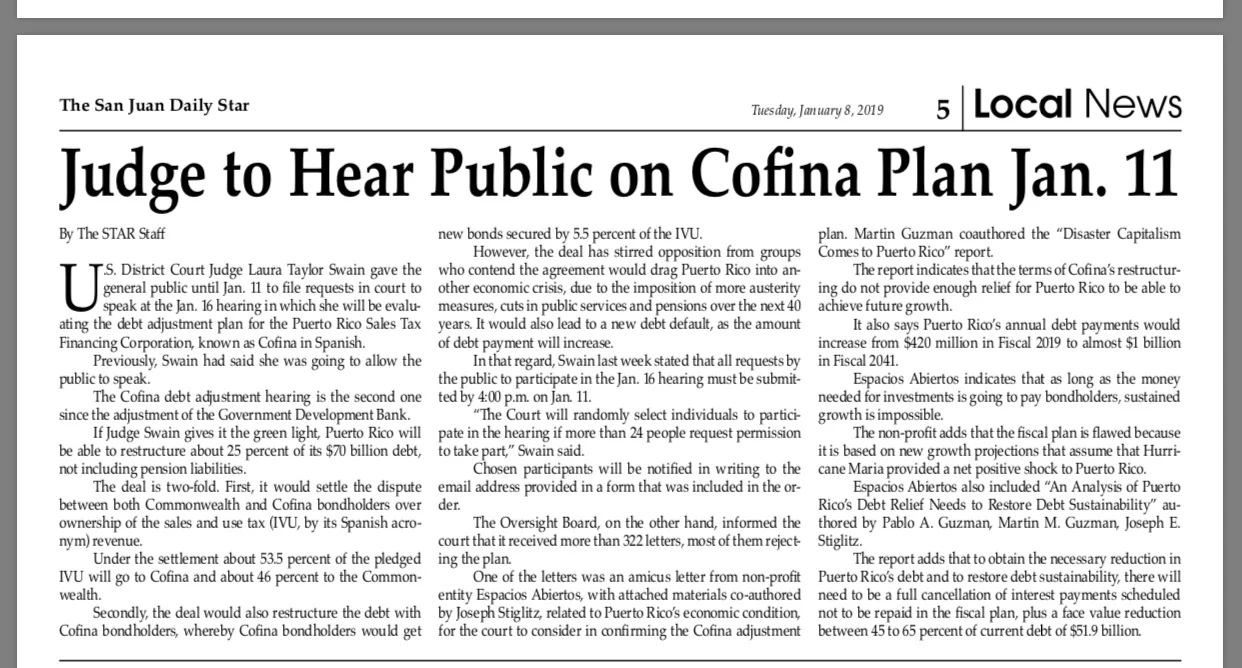
Nobel Laureate Stiglitz, Espacios Abiertos Decry PR “Disaster Capitalism”
NYU Wagner Case Features ETM
Education Through Music and PEG are the subject of a two-part case study at the NYU Wagner Graduate School of Public Service.
San Francisco Foundation Releases “Advancing Equity”
The foundation hired Public Equity Group (PEG) to facilitate a three-phase process:
1) finalize the equity framework;
2) identify how the foundation can leverage all its activities and assets to advance the equity agenda;
3) determine how to align the foundation structure and resources to achieve equity goals, and identify metrics and milestones to gauge progress…
Achieving Impact At Scale In The Equity Movement: PEG joins Bridgespan, FSG, Policy Link And More At Equity Summit
In this session, presenters demonstrated evidence-based strategies for achieving impact at scale, including: Results-Based Accountability (RBA), a disciplined method for accelerating progress and refining organizational strategy; and collective impact, a framework for creating lasting social change through multilevel collaboration. Participants had the opportunity to strengthen their leadership skills, learn from real-world examples, and discover how leaders are mastering these skills to create a more just and fair society.
Trainers: • Jeff Bradach, Managing Partner and Co-Founder, The Bridgespan Group • John Kania, Global Managing Director, FSG • Michael McAfee, President, PolicyLink • JaNay Queen Nazaire, Managing Director for Performance & Results, Living Cities • John Newsome, Founder, Public Equity Group
PolicyLink Staff: Michael McAfee and Jordan Thierry
PEG Clients Launch Puerto Rico Fund

PEG clients, Center For A New Economy (CNE) and Espacios Abiertos (EA), have launched The Puerto Rico Recovery Fund
John Newsome Interview With UC Berkeley
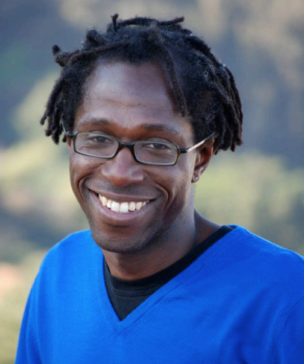
John Newsome was active in the freedom to marry movement through regional activism in the San Francisco Bay Area and Northern California and on a broader stage in the Civil Marriage Collaborative. The excerpts below are part of John’s full interview with the UC Berkeley Oral History Center, in which Newsome discusses his upbringing, coming to terms with his homosexuality, education, and political awareness.
He worked on the ‘And Castro for All’ campaign which addressed racial bias in San Francisco gay bars and then on the outgrowth of that campaign, ‘And Marriage for All,’ which sought to mobilize communities of color around marriage equality.
Download a PDF of John’s full interview here
Childhood:
“My upbringing was complicated… While my mother was raised upper middle class, which was unusual for a black family in the thirties… my father was raised very, very poor, and joined the military as a way to get the GI Bill and go to college … I think, in hindsight, it was a tremendous achievement that he went to college, went to law school. He eventually succumbed to alcoholism, and there was a whole downward spiral, and they divorced, and by the time I was a kid we were struggling ….”
“The year after I started kindergarten [my school] created a Spanish immersion program. My mother was one of the founders. I spent my elementary years… in full-time Spanish instruction… In hindsight, I think my perspective is very rooted in the multicultural exposure that I had then… I was also in a very Jewish community, so identified closely with my Jewish friends. And then ended up taking karate as I approached middle school, and so I was a hodgepodge of all of these different identities, and still am in some ways.”
“My parents were very connected to black culture and community, in ways that I didn’t fully understand until I got much older. I learned just before my father died that he had been the vice president of SNCC [Student Nonviolent Coordinating Committee] at Howard when he was in law school, and my mother had chosen to teach at the University of DC because it was a black university…. I was surrounded by black faculty, black professionals from Howard… I took that for granted growing up. At the same time, I was in schools that had newly desegregated, where a lot of the black students were trapped and ostracized… I experienced a lot of, in hindsight, trauma around being black, and being targeted for speaking white, or being more academic. I played the violin. I think people could tell that I was gay. And I didn’t have a very positive experience.”
Early “consulting”:
“I worked at Stanford for a couple of years … My role was created as a result of a conversation between the President of the university and the mayor of East Palo Alto because Stanford had a long history in East Palo Alto of creating [bad] volunteer programs… My job was to work with students and faculty and community and alums to really understand what it means to be a good partner, and to build programs that were as respectful and rigorous and impactful as possible, which is actually what I do to this day.”
Intersectional Black & LGBT community work:
“Somewhere around probably ’05 or ’06 I was invited to join the Civil Marriage Collaborative [co-leaders the marriage equality movement, with Evan Wolfson/Freedom to Marry] as an advisor. I was a community voice… with stronger linkages in communities of color, hopefully, also someone who works in strategy, and advised as… funders looked at the different policy opportunities… and made investments on a state-by-state basis, in infrastructure, in education program, and campaign…”
“I was asked sometime in the summer [of 2008] if I would consider being field director for the No on Prop 8 campaign, and that was the first sign for me that we probably weren’t on track, because I think that was June, and June is really late to be hiring a field director for a massive statewide campaign. So that was concerning… [Instead a colleague and I] laid out strategy [to] enlist African American LGBT couples and individuals, train them… so they could be [media] spokespeople, organize education events in partnership with clergy and community leaders, write op-ed pieces. An effort to educate the California electorate, and the California public, about the importance of marriage equality [to communities of color].”
Consulting career:
“I care deeply about justice issues, and that will never change. I think the best way for me to play a role is in my day job, as an advisor [rather than an activist]. I work with organizations that are doing, I think, some of the most important work in the world, and I think I can empathize, I think I can bring a set of weird analytic tools [to] nonprofits and community-based organizations…”